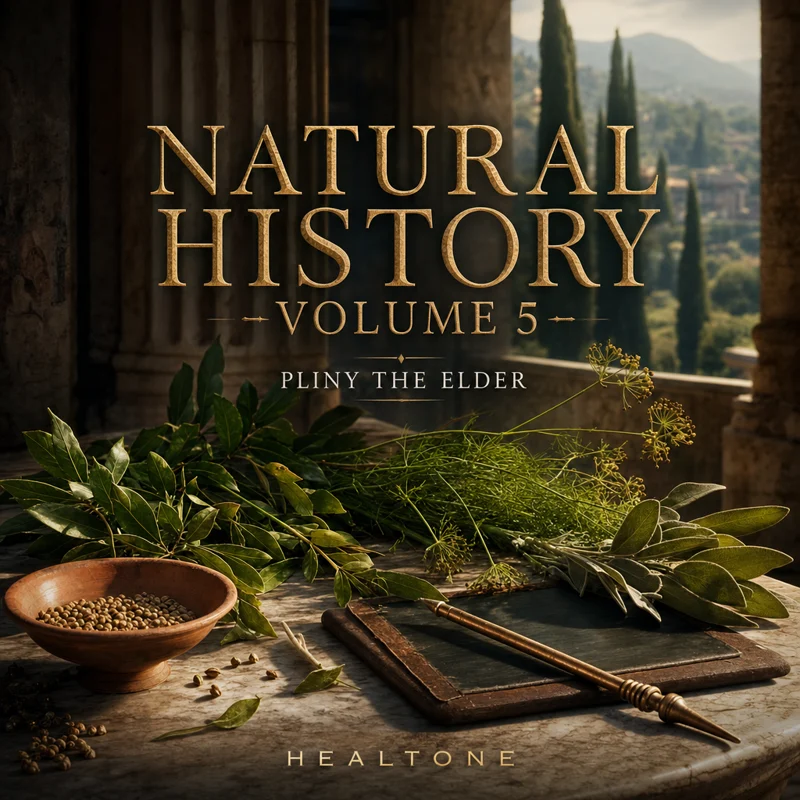
Herbal Remedies
Natural History Volume 5
Pliny the Elder · narrated by LibriVox volunteers
11h 47m$1.99
Owning includes offline downloads and never expires.
Two thousand years old and still astonishing. In this volume of his colossal Roman encyclopedia, Pliny the Elder gathers what the ancient world believed about the earth and its living things: plants, peoples, wonders, and remedies, reported with boundless curiosity. You will discover the roots of herbal tradition itself, where observation, rumor, and marvel share a page, heard as heritage rather than guidance. History's most quotable naturalist, in full voice. Play the sample and listen across millennia.
Inside this audiobook
27 chapters
- 1Book 21, Chapters 1-9:<i></i> The nature of flowers and garlands; garlands and chaplets; who invented the art of making garlands;the severity of the ancients in relation to chaplets; authors who have 13m
- 2Book 21, Chapters 10-21: The rose, twelve varieties of it; the lily, four varieties of it; the narcissus, three varieties of it; violets; the caltha; the scopa regia; the bacchar; saffron; the nature 29m
- 3Book 21, Chapters 22-40: Fabrics which rival the colours of flowers; the amaranth; the cyanos; the petilium; the chrysocome; shrubs; the melothron and origanum; trefoil; thyme; conyza; the flower of J21m
- 4Book 21, Chapters 41-59: Plants which should be sown among flowers for bees; the maladies of bees; the food of bees; poisoned honey; maddening honey; honey that flies will not touch; beehives; the be25m
- 5Book 21, Chapters 60-71: Plants classified according to their leaves; the various kinds of eared plants; the lappa; the chondrylla; plants which blossom three times in a year; the asphodel or royal sp17m
- 6Book 21, Chapters 72-109: Ten remedies derived from the sweet-scented rush; remedies derived from the flowers before mentioned; twenty-one remedies derived from the lilly; sixteen remedies derived fro51m
- 7Book 22, Chapters 1-15: Properties of plants; plants used for adornment; plants for dyeing;the grass crown; remedies derived from other chaplet plants;the erynge; the acanos; the nettle, sixty-one rem29m
- 8Book 22, Chapters 16-32: The Lamium, seven remedies; the scorpio; the leucacantha; the chamaeleon; the anchusa; the pseudoanchusa; the onochilon; the lotus-plant, four remedies; the heliotropium; the 29m
- 9Book 22, Chapters 33-49: The Halimon, fourteen remedies; the acanthus; the bupleuron; the buprestis; the scandix; the caucalis; the scolymos or limonia; the condrion; mushrooms, peculiarities of their27m
- 10Book 22, Chapters 50-56: Propolis, five remedies; influences of aliments upon the disposition; hydromel, eighteen remedies; honied wine, six remedies; wax, eight remedies.11m
- 11Book 22, Chapters 57-82: Remedies derived from grain; various kinds of meal; polenta, eight remedies; fine flour; millet; sesame; barley; bread, twenty one remedies; beans; lentils; chickpeas; lupine;34m
- 12Book 23, Chapters 1-18: Remedies derived from cultivated trees; the vine; omphacium; oenanthe; grapes; grape-stones; raisins; the labrusca or wild-vine; the white-vine; the black-vine; must.22m
- 13Book 23, Chapters 19-33: Particulars relative to wine; surrentine wines; falernian wines; setine wines; other wines; sixty-one observations relative to wine; in what maladies wine should be administer32m
- 14Book 23, Chapters 34-50: The leaves of the olive; the blossom of the olive; white olives; black olives; amurca of olives; omphacium; oil of oenanthe; castor oil; oil of almonds; oil of laurel;oil of c21m
- 15Book 23, Chapters 51-65: The palm; remedies derived from various trees; six observations upon apples; twenty-two observations upon quinces; sweet apples; sour apples; citrus; pomegranates; balaustium;25m
- 16Book 23, Chapters 66-83: Plums; peaches; mulberries; cherries; pine-nuts; almonds; Greek nuts; walnuts; hazelnuts; carobs; the laurel; myrtle; the wild myrtle; summary; authors quoted.32m
- 17Book 24, Chapters 1-21: The antipathiers and sympathies among trees and plants; the lotus of Italy; acorns; mistletoe; the cork-tree; the beech; the cyprus; the cedar; galbanum; storax; the terebinth;36m
- 18Book 24, Chapters 22-43: Resins; pitch; pissasphaltos; the torch-tree; the lentisk; the ash; the maple; the poplar; the elm; the linden tree; the elder; the juniper; the willow; the broom; the myrica;34m
- 19Book 24, Chapters 44-63: The siler; the alder; several varieties of the ivy; the reed; the papyrus; the ebony; the rhododendron; the rhus; rosemary; selago.20m
- 20Book 24, Chapters 64-90: Gum; the white thorn; gum acacia; asphalatos; the yew; the bramble; the rhamnos; lycium; oporice; the chamelaea; the clinopodium; the clematis.25m
- 21Book 24, Chapters 91-120: Different opinions on the dracontium; the aron; the dracunculum; the millefolium; the myrrha; the aproxis; the woolplant; the stratiotes; the plant called Venus comb; gramen;33m
- 22Book 25, Chapters 1-7: When the wild plants were first brought into use; Latin authors; Greek authors; plants, the medicinal properties of which have been miraculously discovered; names of persons who22m
- 23Book 25, Chapters 8-25: Moly; the paeonia; the panaces; hyoscyamos; linozostis; millefolium; hellebore.31m
- 24Book 25, Chapters 26-49: The mithridatia; the polemonia; centaurion; clymenus; gentian; artemisia or ambrosia; nymphaea; plantago; buglossos; buphthalmos; plants that have been discovered by certain n19m
- 25Book 25, Chapters 50-74: Plants which have been discovered by certain animals; dogplant; dictamnon; the emplyment of these plants for injuries inflicted by serpents; the argemonic; agaria; verbenaca; 24m
- 26Book 25, Chapters 75-90: The scorpio; the phrynion; the alisma; remedies against certain poisons; euclea; pericarpum; remedies for diseases of the head; hyssop; psyllion.14m
- 27Book 25, Chapters 91-110: Remedies for diseases of the eyes; mandragora; hemlock; molybdaena; capnos; acoron; cotyledon; remedies for diseases of the teeth; acanthis; ephemeron; labrum venereum; remed31m